Philosophy

Philosophy

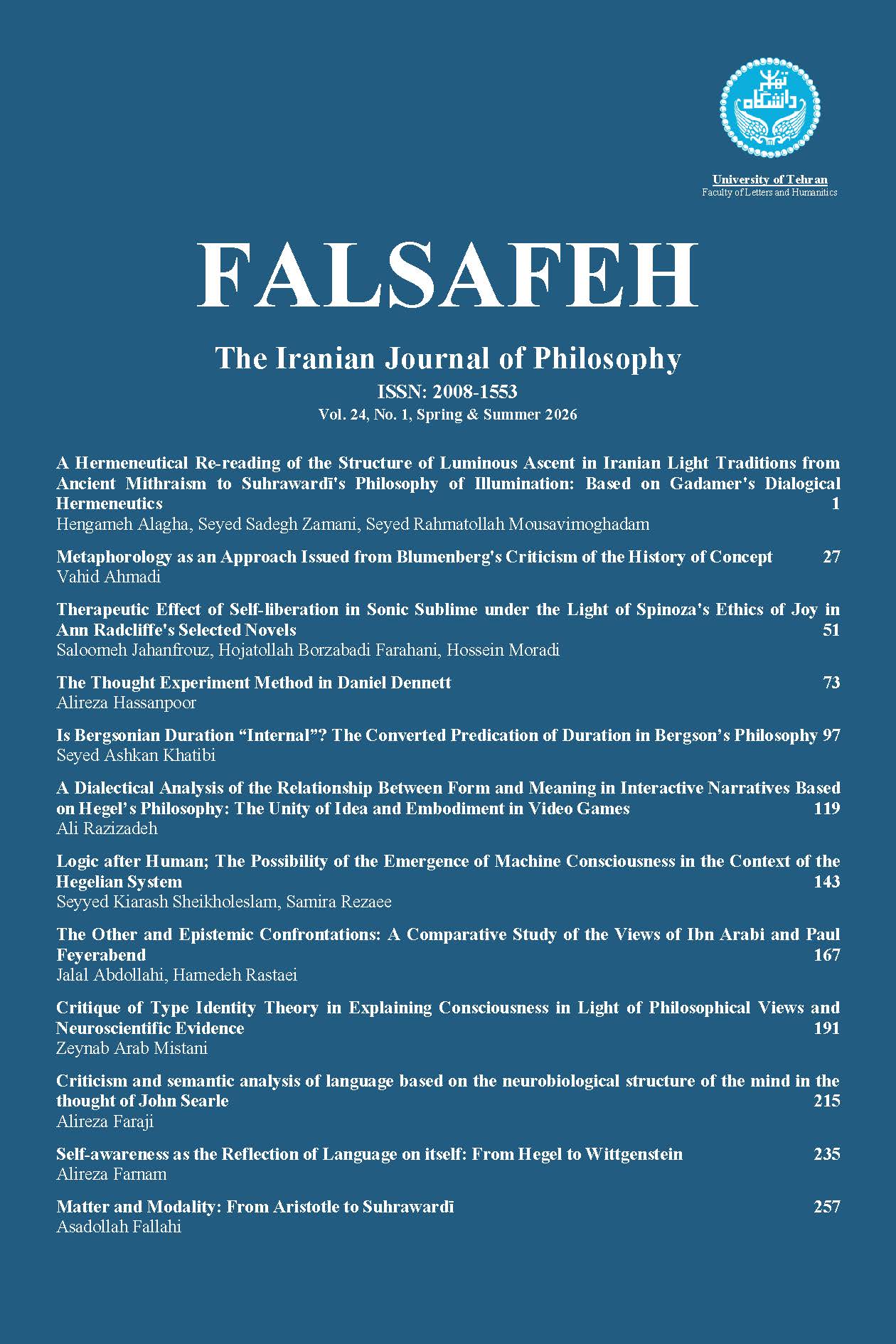
Criticism and semantic analysis of language based on the neurobiological structure of the mind in the thought of John Searle

Document Type : Scientific-research

Author
Associate Professor, Department of Philosophy, Payam Noor University, Tehran, Iran.
Abstract
John Searle, a contemporary neuroscientist, as one of the most prominent analytical and cognitive philosophers, analyzed the framework of mind and consciousness based on the physical interactions of the brain, that is, nerve firings, and according to her belief, consciousness is the product of the high level of action and reaction of brain neurons, and the nervous structure and its actions are considered the low level of consciousness. According to Searle, one of the most important aspects of consciousness is the aspect of empathy that makes the conscious subject aware and related to the world outside himself. In Searle's philosophy, language is the most fundamental aspect of consciousness. According to him, language has both syntactic (synthetic) and semantic (semantic) characteristics. In order to better understand the language, he discussed speech verbs and language rules, which shows the role of language as the main factor of human communication and the development of consciousness. The relationship of the mind, as the place of establishment of consciousness, with language, as the exclusive tool of the conscious subject in order to express mental states, is something that Searle has paid special attention to based on the neurobiological method and offers a new explanation of it based on naturalistic principles. In the current research, we will analyze this problem, how can we reach the semantic concepts of language by relying on Searle's biological, neurological and philosophical teachings about the physical structure of the brain?
Keywords
Subjects

Bennett, Maxwell, (2007) Neuroscience and philosophy: Brain, Mind, and language. Daniel Dennett, peter Hacker, John Searle. Columbia university press.
Chomsky, Noam (2013). Language and Mind, translated by Koresh Safavi, Tehran, Hermes. In Persian.
Herre, Rome (2019). Philosophical introduction to cognitive sciences, translated by Hossein Sheikh Rezaei, Majid Davoudi Nabi, Tehran, Farhang Eshar Nou. In Persian.
Krkac, Kristijan (2012) A custodian of Grammar, Essy on Wittgenstein’s university press of America.
Martinich, P.A. (2001) A Companion to Analytic Philosophy. by David Sosa. Blackwell PUB.
Ritty, John, J. (2012). Brain users' guide, translated by Reza Amir Rahimi, Tehran, Nilufar. In Persian.
Rust, Joshua. (2009) John Searle. Continuum International publishing Group.
Searle, John (1387) Speech Acts, a survey in the philosophy of language. Translated by Mohammad Ali Abdulahi. Qom Institute of Islamic Sciences and Culture. In Persian
------- (2016), the secret of knowledge. Translated by Seyyed Mostafa Hosseini, Tehran, Markaz. In Persian
------- (2016), A short introduction to the mind. Translated by Mohammad Yousefi. Tehran, Nei. In Persian
------- (2018). Choice and neurobiology. Translated by Mohammad Yousefi, Tehran, Ghoghnous. In Persian
------- (2019). Philosophy in the new century, translated by Mohammad Hossein Yousefi, Tehran, Ghoghnous. In Persian
------ (1400) Construction of social reality, translated by Maisham Mohammad Amini, Tehran, Farhang Eshar Nou. In Persian
------. R. John. (1979) Expression and Meaning Cambridge university press.
------. R. John (1999) Intentionality. An essay in the philosophy of mind. Cambridge university press.
------. R. John. (2002) consciousness and language Cambridge university press.
Smith, Barry. (2003) John Searle, Cambridge press 2003.
Wittgenstein, Ludwig. (1389), Philosophical Researches, translated by Fereydoun Fatemi, Tehran, Markaz. In Persian
Volume 24, Issue 1 - Serial Number 46
September 2026
Pages 215-234

  • Receive Date 02 October 2025
  • Revise Date 20 January 2026
  • Accept Date 18 February 2026