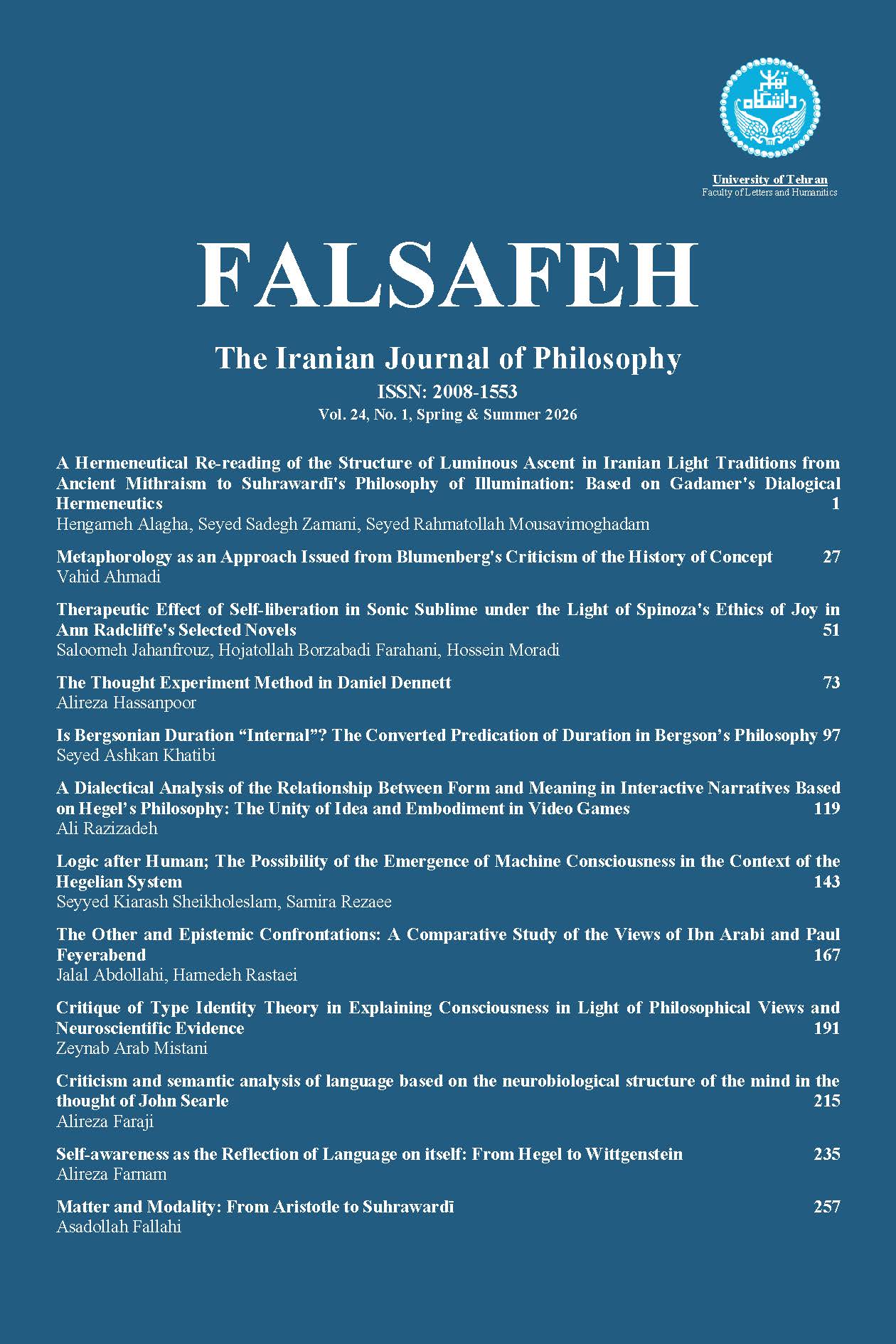
Volume & Issue: Volume 24, Issue 1 - Serial Number 46, September 2026, Pages 1-296 
Number of Articles: 12

A Hermeneutical Re-reading of the Structure of Luminous Ascent in Iranian Light Traditions from Ancient Mithraism to Suhrawardī's Philosophy of Illumination: Based on Gadamer's Dialogical Hermeneutics

Pages 1-26

https://doi.org/10.22059/jop.2026.398673.1006921

Hengameh Al Agha, Seyed Sadegh Zamani, Seyed Rahmatollah Mousavimoghadam

Abstract Light in Iranian intellectual traditions appears as a multilayered ontological principle that shapes truth, inner transformation, and the emergence of meaning. Using Gadamer’s philosophical hermeneutics, this study examines the structure of luminous ascent in Mithraism, Suhrawardī’s Illuminationism, and Khosrowanian wisdom, focusing on how light structures the seeker’s movement toward understanding. The methodology draws on interpretive analysis of philosophical and mystical texts, study of pre-Islamic light-centered traditions, and examination of luminous symbolism in Iranian–Islamic visual culture. The findings indicate a shared pattern of inner transformation across the three traditions: planetary initiation in Mithraism, ascent to the Eighth Climate and the encounter with the Crimson Archangel in Illuminationist thought, and the manifestation of Farr-e Izadi as a sacred radiance that marks existential readiness in Khosrowanian wisdom. Farr-e Izadi emerges not as a mythic motif but as an interpretive event revealing the seeker’s capacity for truth. Through the lens of Gadamer’s concept of horizon, light becomes the condition for meaning to unfold-an experiential field where understanding appears rather than something constructed by the subject. Thus, the Iranian luminous tradition can be understood as an interpretive system in which meaning arises through participation in the luminous order of being and remains open to contemporary hermeneutic reflection.

Metaphorology as an Approach Issued from Blumenberg's Criticism of the History of Concept

Pages 27-50

https://doi.org/10.22059/jop.2026.410554.1006981

Abstract In Hans Blumenberg's philosophy, metaphor plays a special role. This special role consists in adding logic to metaphor that in turn giving rise to the logic of metaphor. In this philosophy, the logic of metaphor emerges from the heart of the history of concepts (Begriffsgeschichte), traces the path of concept formation, and ultimately transforms into a fundamental mode of approaching reality. This fundamental mode of approach is the outcome of the logic of metaphor, which, through its discussion of the absolute metaphor, distinguishes itself from other philosophical approaches, such as phenomenology and hermeneutics. The question is: which critique of the history of concepts makes this logic of metaphor possible? Answering this question forms an important part of our effort to reveal this logic as an approach. The critique of the conception of the history of concepts regarding history makes this possible. Here a radical conception of history emerges, according to which history cannot be brought into the present because it is absolutely impassable. This conception of history results from the fact that, instead of following history as a longitudinal section in the history of concepts, we can also consider it as a cross-sectional cut. This cross-sectional cut is precisely looking from the perspective of metaphor and pursuing the path of concept formation. This cross-sectional cut enables us to discern, in every taking of a stance toward the world, which negation that stance has incorporated within itself. Blumenberg calls such work typology and, through it, measures the power of the logic of metaphor as an approach. Conceptual stance-taking is not the complete and final expression of reality, but rather the result of a fundamental certitude regarding the human being's stance toward the world. Ultimately, the logic of metaphor establishes itself as an approach, with regard to language, in a formulated and distinctive manner that attends to the excess of language over meaning. This understanding is rooted in the rhetorical knowledge's comprehension of language.

Therapeutic Effect of Self-liberation in Sonic Sublime under the Light of Spinoza's Ethics of Joy in Ann Radcliffe's Selected Novels

Pages 51-71

https://doi.org/10.22059/jop.2026.401295.1006944

Saloomeh Jahanfrouz, Hojatollah Borzabadi Farahani, Hossein Moradi

Abstract This research examines the connection between Spinoza’s “Ethics of Joy” and the aesthetics of the sublime in Ann Radcliffe’s novels. It posits that Spinoza’s concept of joy—as a transition from passivity to activity and an increase in “ontological power”—is central to how Radcliffe’s characters engage with the sublime in nature and music. Contrary to the typical Gothic association of the sublime with fear, this study argues that Radcliffe uses music and nature to create an “epistemic liberation.” This experience, aligned with Spinoza’s “intellectual intuition” and its resulting pleasure, views the sublime not as subject destruction, but as a connection to the totality of existence (Substance). Music acts as a metaphysical mediator, resolving internal conflicts into lasting harmony and joy.

The Thought Experiment Method in Daniel Dennett

Pages 73-96

https://doi.org/10.22059/jop.2026.398787.1006920

Alireza Hassanpoor

Abstract Intuition pumps are intellectual tools with multiple capabilities that can be used to better understand complex philosophical problems and to reveal, question, and correct our common notions and assumptions. In addition, this intellectual tool plays a fundamental role in bridging the gap between abstract philosophical reflections and empirical scientific research. According this method, by presenting scenarios, they engage the audience's imagination and provoke critical thinking and a deep reconsideration of their beliefs on various issues, thereby encouraging deeper exploration of these issues. However, with all the strengths that intuition pumps have, we must be careful in using them; in other words, they should not be considered equivalent to formal logical arguments and rigorous empirical research, but rather as supplementary tools to the standard scientific and philosophical methods. For this reason, Dennett always emphasizes understanding their potential to mislead, using them cautiously, and using criteria to evaluate their results. For Dennett, “turning the knobs,” compatibility with empirical evidence, and avoiding oversimplification are among the criteria for evaluating intuition pumps. Ultimately, by recognizing the strengths and weaknesses of intuition pumps, we can broaden the scope of philosophical methodology and use more possibilities for complex philosophical research and reflection, contribute to bridging the gap between philosophy and empirical science and to greater interaction between the two, and, most importantly, prevent dogmatism and narrow-mindedness by opening the way for constant revision and rethinking. In this research, information is collected by using library resources and the content is presented through a descriptive-analytical approach.

Is Bergsonian Duration “Internal”? The Converted Predication of Duration in Bergson’s Philosophy

Pages 97-118

https://doi.org/10.22059/jop.2026.409936.1006975

Seyed Ashkan Khatibi

Abstract This paper argues that Bergsonian duration (la durée) is not inherently an internal phenomenon. However, this proposition arises by considering two distinct types of discourse within Bergson’s philosophy: on one hand, his insistence on the metaphysical nature of duration and its irreducibility to any internal or psychological state; and on the other, the undeniable prominence and frequency of references to the ‘inner’, the ‘psyche’, and ‘consciousness’ when he discusses duration. This article resolves this dichotomy by introducing the distinction between privilege and primacy. However, to legitimize speaking of duration in general (not duration in a specific work among Bergson's oeuvre), an initial effort will be made to offer a methodological proposal for a particular reading of the relationship among Bergson's works. Then, based on this proposal, the second effort and the primary finding of the article will be to demonstrate that applying duration to the psyche is of the kind of converted predication (predication by conversion, aks al-haml). Finally, the significance of this finding lies in liberating Bergsonian duration from an interpretive framework that holds both historical and logical precedence over other interpretations: the spiritualistic reading of Bergson. This spiritualistic reading serves as the foundation for two other misinterpretations of Bergson (specifically, naive realism and a form of correlationism). Consequently, demonstrating the falsity of the spiritualistic reading effectively separates Bergsonian duration from all three erroneous readings.

A Dialectical Analysis of the Relationship Between Form and Meaning in Interactive Narratives Based on Hegel’s Philosophy: The Unity of Idea and Embodiment in Video Games

Pages 119-142

https://doi.org/10.22059/jop.2026.397762.1006913

Ali Razizadeh

Abstract In Hegel’s aesthetics, art is not merely the representation of the Idea, but a moment in which the Idea is actualized in a sensuous and formal configuration. The internal unity of content and form, conceived as the embodiment of the Idea, is the fundamental criterion of artistic authenticity. This study aims to investigate the possibility of realizing this dialectical unity within a novel framework of aesthetic experience. Accordingly, the central question of this article is how, in contemporary interactive art forms, particularly in interactive narratives within video games, the Idea might emerge not through representational form, but through lived and participatory experience. The research adopts a philosophical-conceptual method grounded in dialectical analysis and comparative interpretation, drawing on core Hegelian notions such as Idea, embodiment, negation, necessity in form, and the transition from sense to spirit. The findings suggest that when a work’s form is constructed as temporally extended, nonlinear, and interactive, it can enable a mode of dialectical awareness in which meaning is not pre-given but generated through the subject’s active engagement with form. In certain cases, breakdowns in narrative coherence, structural dissonance, or the absence of language foster philosophical reflection on limits, and this negative truth itself may signify a mode of the Idea’s realization. Thus, Hegelian aesthetics may be conceptually extended to analyze emergent artistic forms without abandoning its foundational principles.

Logic after Human The Possibility of the Emergence of Machine Consciousness in the Context of the Hegelian System

Pages 143-166

https://doi.org/10.22059/jop.2026.411568.1006988

Sayed Kiarash Sheikholeslam, samira rezaee

Abstract This article reinterprets the system of Georg Wilhelm Friedrich Hegel in relation to the history of cybernetics and artificial intelligence, arguing that—contrary to the predominantly negative readings among contemporary philosophers—the possibility and realization of the technological singularity are neither impossible nor foreclosed within a Hegelian framework. The paper claims that the Hegelian system contains fundamental provisions that pave the way for the emergence of machine consciousness and thereby make possible the advent of genuine or singular artificial intelligence. It begins by examining the history of the concept of singularity from von Neumann to Kurzweil and critiques various Hegelian interpretations of artificial intelligence. It then compares second-order cybernetics with Hegel’s dialectical principle in order to restore the conceptual possibility of singularity. Subsequently, through an analysis of the dialectic of means and ends in Hegel’s subjective logic, along with Marx’s critique of it, the article shows that Marx’s critique inadvertently transfers the mystification of the Idea to tools and machines, thereby laying the groundwork for a form of post-human subjectivity. Finally, by analyzing the resistance of the object in light of quantum physics and quantum computing, the paper argues that singularity is not a future-oriented event but rather a dialectical necessity arising from the internalization of negativity within matter. It concludes that singularity inaugurates a “post-human logic” that resolves the tension between technique and self-consciousness through the dialectical unity of tool, end, and consciousness.

The Other and Epistemic Confrontations: a Comparative Study of the Views of Ibn Arabi and Paul Feyerabend

Pages 167-189

https://doi.org/10.22059/jop.2025.387463.1006872

Jalal Abdollahi, Hamedeh Rastaei

Abstract The purpose of this article is to compare the approach of Ibn Arabi and Feyerabend in facing the "other" and epistemic confrontations. Despite the background and historical differences of these two thinkers, both of them consider "the other" and epistemic confrontations as an opportunity to upgrade and elevate the epistemological dimensions of a person. Ibn Arabi's and Fayraband's approach to the system of existence is closely related to their view in the field of epistemology. The encounter of these two thinkers with "the other" and different opinions is rooted in their ontological system. In Ibn Arabi's ontological system, the difference between beings is due to the difference between divine names. This existential and ontological difference also finds its way to the field of knowledge and causes a plurality of opinions and ideas. From Feyerabend's point of view, existence is a complex and rich thing, and the possibility of understanding its truth is completely ruled out. In the eyes of both, the possibility of being able to grasp the whole truth from a specific point of view is ruled out. Instead of recommending the elimination of the "other", they recognize multiple opinions and refer to epistemological confrontations as an opportunity to strengthen views and gain a deeper understanding of the truth.

Critique of Type Identity Theory in Explaining Consciousness in Light of Philosophical Views and Neuroscientific Evidence

Pages 191-214

https://doi.org/10.22059/jop.2026.402726.1006948

Zeynab Arab Mistani

Abstract The mind-body problem remains one of the deepest philosophical issues, examining the relationship between the thinking aspect of human beings and their material basis. Following the introduction of a substantial distinction between mind and matter, this problem evolved into a confrontation between dualism and physicalism, turning the philosophy of mind into a field of profound reflection. Physicalism, which regards all phenomena as material, faces serious challenges in accounting for consciousness, particularly the inadequacy of type-identity theory in explaining the subjective qualities (qualia) of experience. Employing a descriptive-explanatory method and drawing on insights from cognitive neuroscience, this study seeks to recast this longstanding puzzle as an empirical question: How does the brain, as a material entity, give rise to the mind, a constellation of conscious experiences? Type-identity theory, as one of the most prominent reductive physicalist approaches, identifies mental states with neurophysiological processes and offers a framework for explaining consciousness based on the principle of metaphysical simplicity and consistency with causal closure. Nevertheless, the theory proves inadequate when confronted with the subjective qualities of experience, the complexities of multiple realizability, and explanatory gaps. Through a systematic critique of the metaphysical presuppositions of physicalism, the present research highlights the shortcomings of type-identity theory. It emphasizes the need for integrative approaches -including non-reductive physicalism and phenomenological analyses- for a deeper understanding of consciousness. It is expected that this study will contribute to advancing interdisciplinary dialogues in the fields of philosophy of mind and neuroscience.

Criticism and semantic analysis of language based on the neurobiological structure of the mind in the thought of John Searle

Pages 215-234

https://doi.org/10.22059/jop.2026.403532.1006952

Alireza faraji

Abstract John Searle, a contemporary neuroscientist, as one of the most prominent analytical and cognitive philosophers, analyzed the framework of mind and consciousness based on the physical interactions of the brain, that is, nerve firings, and according to her belief, consciousness is the product of the high level of action and reaction of brain neurons, and the nervous structure and its actions are considered the low level of consciousness. According to Searle, one of the most important aspects of consciousness is the aspect of empathy that makes the conscious subject aware and related to the world outside himself. In Searle's philosophy, language is the most fundamental aspect of consciousness. According to him, language has both syntactic (synthetic) and semantic (semantic) characteristics. In order to better understand the language, she discussed speech verbs and language rules, which shows the role of language as the main factor of human communication and the development of consciousness. In order to better understand the language, she discussed speech verbs and language rules, which shows the role of language as the main factor of human communication and the development of consciousness. the conscious subject in order to express mental states, is something that Searle has attention to based on the neurobiological method and offers a new explanation of it based on naturalistic principles. In the current research, we will analyze this problem, how can we reach the semantic concepts of language by relying on Searle's biological, neurological and philosophical teachings about the physical structure of the brain?

Self-awareness as the Reflection of Language on itself: From Hegel to Wittgenstein

Pages 235-255

https://doi.org/10.22059/jop.2026.404965.1006960

Alireza Farnam

Abstract The nature of self-awareness remains a fundamental question in philosophy of mind, phenomenology, and the philosophy of language. Although commonly defined as the subject’s awareness of itself, this notion conceals profound conceptual and ontological challenges that have preoccupied philosophers from Hegel to Wittgenstein. The enduring question is whether self-awareness should be viewed as a purely mental reflection or as something that arises within and through language itself. This paper advances the thesis that self-awareness is not merely a mental state but a linguistic event. What we call the awareness of the self is, at a deeper level, the manifestation of language’s reflexive capacity to describe and interpret its own operations. In this view, self-awareness emerges when language becomes capable of turning its own structure and function into the content of discourse, thus transforming language from a communicative tool into a self-reflective medium. While a wide range of philosophical traditions—from Hegelian dialectics and Husserlian intentionality to Islamic mysticism and later linguistic theories—have examined self-awareness, most have overlooked the constitutive role of language in enabling self-reflection. This study seeks to illuminate this neglected dimension through a polyphonic philosophical dialogue, demonstrating that self-awareness can be conceived as the reflexive act of language upon itself. Furthermore, this perspective outlines an objective framework for the experimental investigation of self-awareness, suggesting that by grounding the phenomenon in linguistic mechanisms, the study of consciousness may move from a subjective domain toward an empirically testable and objective field of inquiry.

Matter and Modality: From Aristotle to Suhrawardī

Pages 257-284

https://doi.org/10.22059/jop.2026.403421.1006950

Asadollah Falahi

Abstract In Aristo-Avicennan logic, a distinction is made between the matter and modality of propositions. This distinction is not very clear in Aristotle's works, and although Al-Fārābī made the distinction between matter and modality, his distinction is neither stated nor defined clearly. Unlike these two great teachers of logic, however, in the Avicennan tradition, there are at least two clear but different approaches to the distinction between matter and modality: (1) Avicenna explicitly considers modality as verbal and defines matter as a non-verbal "state of the predicate in relation to the subject," or in other words, the modality is signifying. (2) Suhrawardī, however, considers matter to be the proposition itself without modality or without modality and negation. Logicians between Avicenna and Suhrawardī, such as Al-Ghazālī and Abū al-Barakāt al-Baghdādī, sometimes had ambiguous approaches that were probably not without influence in the formation of Suhrawardī's approach. This article provides a critical account of these two approaches. Since Muslim logicians after Suhrawardī, influenced by these two approaches, have presented very conflicting views on the distinction between matter and modality, and since the examination and criticism of their views far exceed the scope of one article, I have devoted a critical examination of their views and my final analysis of the history of developments on this subject to another article in this field.