February 2026
December 2025, Pages 1-536

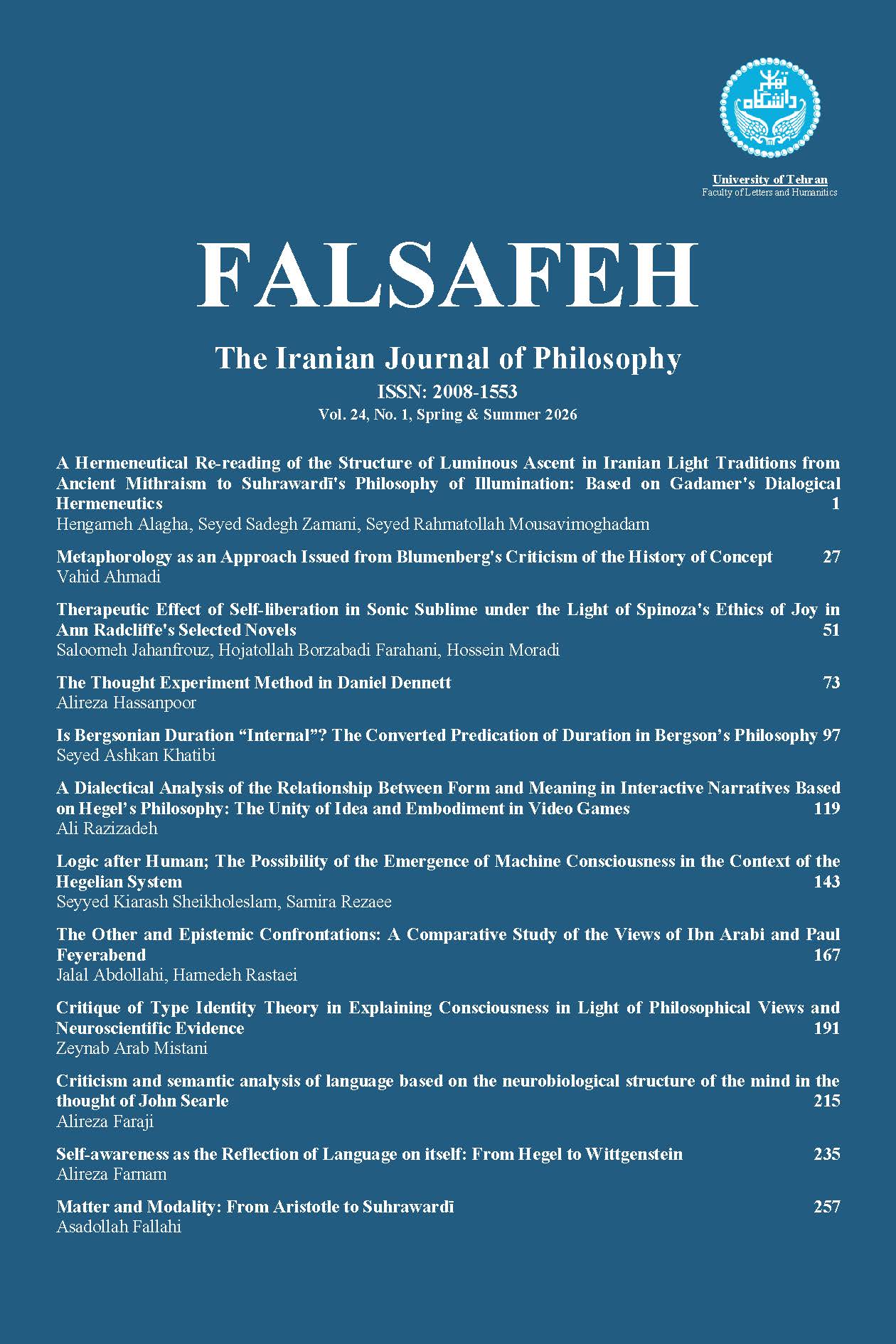
FALSAFEH

FALSAFEH, the biannual journal of the Faculty of Literature and Humanities at the University of Tehran, is a scientific-research publication dedicated to the field of philosophy and its related disciplines. It is published a maximum of two times per year.

Operating within the domain of philosophy, the journal introduces the latest research findings of scholars and university faculty to the academic community. Philosophy, as a discipline, is entrusted with the task of philosophical and rational inquiry into its own nature and fundamental doctrines. By considering both Islamic and Western philosophical perspectives, the journal strives to address diverse viewpoints within the field and to publish articles that adhere to a scientific and research-based standard.

Based on letter No. 3780/11/3, dated May 8, 2010, from the Commission of Scientific Publications of the Ministry of Science, Research, and Technology, FALSAFEH has been granted the rank of "Scientific-Research" journal.

The University of Tehran Journal of Philosophy strives to achieve the following objectives:

  • To acquaint the scientific community with the latest works of researchers and thinkers in the field of philosophy.
  • To critique Western philosophy and work towards the development of Islamic philosophy.
  • To promote the application of philosophy.
  • To demonstrate the rich history and rigor of Islamic philosophy.
  • To move towards theory-building and innovation in the field of philosophy.
  • To respond to doubts and questions concerning philosophical issues in both domestic and international arenas.

Journal Information

  • Journal Title: FALSAFEH (فلسفه)
  • License Holder: Faculty of Literature and Humanities, University of Tehran
  • Publisher: University of Tehran Press
  • English Title: FALSAFEH
  • Scientific Group (Subject): Humanities
  • Sub-group: History - Research - Periodicals
  • Scientific Rank: Scientific-Research (Elmi-Pajouheshi)
  • Date of Accreditation: May 8, 2010
  • Peer Review Type: Double-blind, anonymous, and confidential
  • Journal access status: Open Access
  • Average Initial Review Time: Approximately 3 weeks
  • Average Peer Review to Acceptance Time: 3-4 months, with a minimum of two reviewers
  • Acceptance Rate: 14%
  • Publication Frequency: Biannual
  • Journal Language: Persian (Abstracts and references in both English and Persian)
  • Publication Type: Electronic
  • Access Type: Open Access (full text)
  • Print ISSN: 2008-1553
  • Electronic ISSN: 2716-X974
  • Citation Style: APA
  • Phone: +98 21 61112999
  • Journal Email: philosophyj@ut.ac.ir
  • Website: https://jop.ut.ac.ir
  • Article Processing Charge (APC): Yes
  • Final Acceptance and Publication Fee: Yes
  • Copyright: The journal follows the international Creative Commons Attribution (CC BY) license. The copyright of the articles belongs to the authors, who are the owners and rightful holders of the copyright for their work.
  • Committee on Publication Ethics (COPE): The journal "FALSAFEH" respects the ethics of publication and adheres to the guidelines, principles, and regulations of the Committee on Publication Ethics (COPE). It also complies with the executive bylaw of the Law on the Prevention and Combating of Fraud in Scientific Works.
  • Plagiarism and Similarity Check Policy: In accordance with an agreement with Sinaweb, all submitted articles will be checked for similarity using plagiarism detection software (e.g., Samim-Noor, Hamta-Nevis) before entering the peer-review process.

Important Notice for Authors

The journal will charge a fee after the article has been accepted for publication. However, the republication of information from this database is free, provided the source is cited. As per the request of the Commission of Scientific Publications of the country, it is mandatory for authors to register and display a free ORCID iD and to use a university or institutional email address. Therefore, authors are requested to obtain an ORCID iD and a university/institutional email before submitting their manuscript.

Corresponding Author

The corresponding author can be a faculty member of a university, center, or research institute. The submission of the article is free, but a written confirmation letter from the corresponding author and the required forms must accompany the manuscript. Master's and PhD students cannot submit an article as the corresponding author on their own. The responsibility for ensuring the absence of plagiarism, data fabrication, and misuse of artificial intelligence lies with the authors.

Required Files and Forms

The essential files that must be submitted through the article submission system are:

  1. The main manuscript file (without the authors' names and formatted according to the journal's template/guidelines). (Please refer to the "Guide for Authors" section).
  2. The title page file containing the authors' details.
  3. The Commitment Form (must include the article title and the full names of all authors and be signed by all of them). (Please refer to the "Guide for Authors" section).
  4. The Conflict of Interest and Authorship Agreement Form (must be signed by the corresponding author and uploaded with the manuscript file). (Please refer to the "Guide for Authors" section).

Article Template

The final version of the article, after completing the peer-review and acceptance process, must be submitted in the journal's article template. Otherwise, it will not be processed for publication. (Please refer to the "Guide for Authors" section).


Note: For finally accepted articles, authors must prepare an extended English abstract of 1000 to 1200 words, in addition to the short English abstract. This extended abstract must be placed in the article according to the sample template and sent along with other supplementary files via the journal's system. Artificial intelligence (AI) tools may be used to edit the English abstract for the purpose of reviewing spelling, grammar, and rewriting the text.

The Journal of Philosophy will charge a fee of 1,500,000 Rials for the initial review and, upon article acceptance, a publication fee of 4,500,000 Rials (totaling 6,000,000 Rials). To this end, after notification from the journal office, the aforementioned amount must be paid through the online portal available on the journal's website. Alternatively, the amount can be deposited into the following account, and a copy of the deposit slip must be sent to the journal's email.

  • Account Number: 4001070103006825
  • IBAN (SHABA): IR830100004001070103006825
  • Deposit ID: 314070174140107000000002002202
  • Account Name: University of Tehran - Centralized Account for Specialized Funds, Central Bank of the Islamic Republic of Iran.

                               ISSN Record     مرکز اسناد و کتابخانه ملی 

Particularity: the Central Category of the Aesthetic in Lukacs‘ Aesthetic System

Pages 1-25

https://doi.org/10.22059/jop.2025.389487.1006880

marzieh ebrahimi, Hadi Rabie

Abstract In this paper, I reconstruct Georg Lukacs’ argument, as it appears in his 1963 the specificity of the Aesthetic. In Lukacs’ point of view the theory of reflection provides the common basis for all forms of theoretical and practical mastery of reality through consciousness. Thus it is also the basis for the theory of the artistic reflection of reality. The central idea of this reconstruction is to elaborate the specific character of the artistic reflection of reality in keeping with the goal it sets itself based on dialectal materialism. That is to say; to provide a picture of reality in which the contradiction between appearance and reality, the individual and the universal, etc., is so resolved that the two converge and provide a sense of an inseparable totality based on its historical genesis. For achieving this goal necessitates a reorganization of the relations between categories of reflecting reality, one should see what specific forms, relations, proportion, etc. does the categories common to all reflection receive in aesthetic positing? What becomes clear in the light of this reconstruction is that in Lukacs reorganization of the categories, the category of particularity, which is the synthesis of categories of universalization and individualization and based on their dialectical relations, is the main category of aesthetics and the work of art takes place in this category. Thus, in speaking simply of itself, each facet of the artwork, through its immersion in the whole cannot help reflecting the concrete reality in its totality.

The Possibility or Impossibility of linguistic Incommensurability in Comparative Studies

Pages 27-47

https://doi.org/10.22059/jop.2025.389819.1006884

Hasan Ahmadizade

Abstract Comparative studies scholars believe that the most difficult challenge facing researchers in this field, first and foremost, is the possibility or impossibility of comparability between different traditions, cultures, and schools of thought. This difficulty manifests itself most notably in the field of comparative research in philosophy and theology. Philosophers engaged in comparative explorations of texts and cultures of ancient philosophical traditions have found themselves confronted with a plethora of terms and vocabulary for which finding equivalents has been very difficult. In this essay, with reference to three types of incommensurability—fundamental, evaluative, and linguistic—we will address two general approaches regarding the possibility or impossibility of linguistic incommensurability. On the one hand, we will refer to the view of those like Davidson, who, in contrast to those like MacIntyre, defend the commensurability and reject the incommensurability between different traditions and cultures. On the other hand, we will critique and evaluate these two general approaches. In the issue of linguistic incommensurability, the emphasis is on whether it is still possible to compare cultures, traditions, and schools of thought arising from them, given the different terms, language, and contexts in which they are formed in different cultures.

Wittgenstein’s Philosophy of Language, Realism or Idealism?

Pages 73-49

https://doi.org/10.22059/jop.2025.397925.1006915

Hossein Shaqaqi

Abstract The later philosophy of Ludwig Wittgenstein is interpreted by some commentators as realist, while others regard it as idealist. Each of these camps supports its interpretation by citing specific passages from his works. The first group primarily bases its argument on ideas such as the centrality of ordinary understanding and everyday language in Wittgenstein’s philosophy of language. In contrast, the second group emphasizes the primacy of language over any form of theorizing and interprets language as playing a subjective role in his work. Beyond these two camps, a third group of interpreters understands Wittgenstein’s thought as neither realist nor idealist. This group argues that Wittgenstein rejects the kind of metaphysical theorizing characteristic of the history of philosophy and therefore cannot be aligned with either idealism or realism. In this paper, after presenting the reasons advanced by all three groups of interpreters, I defend an idealist interpretation based on two main points. The first concerns understanding idealism in Wittgenstein’s thought through his notion of family resemblance. The second concerns how idealism can be attributed to Wittgenstein’s philosophy in a way that does not conflict with his rejection of metaphysical theorizing.

A Rereading of Plato's and Aristotle's Educational Philosophies in Light of Davidson's Concept of the "Relational Self"

Pages 75-97

https://doi.org/10.22059/jop.2025.389644.1006881

Kamrun Shahbazi, Mohammad Hassan Karimi, Babak Shamshiri, Amin Izad panah

Abstract To illustrate the distinct and nuanced educational system that arises from a relational perspective on the concept of "self." This article attempts to first, analyze Davidson's concept of "self" and then, by introducing Plato's and Aristotle's ideas about the concept of "self", attempt to express their educational system by comparing them with the concept of "relational self". Analyzing the concept of "relational self" based on the documentary-library methods and drowing out the educational systems of Plato and Aristotle using the deductive methods. Perhaps the most notable instance of the definition of the "relational self" is Davidson's image of it. This "relational self" possesses two important characteristics: relation with otherness and relation with the world. According to this definition, Plato's idea of the "self" stands in opposition to the "relational self" because of his dualism. Aristotle elucidates the concept of the "relational self" by presenting the theory of hylomorphism. However, due to his assumption of an active intellect that is entirely separate from matter and his belief in a singular entelechy for all humans, he cannot fully meet the criteria for a relational definition of "self". The outcome of this definition of the relationality of "self" is an enhanced focus on the role of the “other,” the “world.” The distinctive identity of individuals and educational institutions is shaped not by top-down directives from the ministry, but by the relationships among students, peers, and teachers, as well as the relations between schools and other institutions. Physical education is regarded as essential as the cultivation of mental capacities. Davidson's holistic concept of “self” emphasizes the integration of descriptive and normative knowledge, and also making no distinction between natural and social sciences. Educational policy, curriculum, and the necessary rationality and agency for implementing changes all attain a relational status and become down-top. This relationality can also cover fundamental challenges of pedagogy.

A Comparing the Concept and Phenomenological Function of Intuition of Essence According to Descartes and Husserl

Pages 99-121

https://doi.org/10.22059/jop.2025.387264.1006870

Abdolreza safari

Abstract This article, based on a descriptive-analytical method, focuses on the phenomenological role and function of intuition of essence in Descartes and Husserl. Although the author introduces intuition as a common methodological process in the phenomenology of Descartes and Husserl, he observes clear differences between them in terms of the working components in the category of intuition. By making a necessary distinction between the mental actions of intuition and deduction, Descartes considers intuition to be merely the creator of immediate intrinsic self-evidence and worthy of the basis of the philosophy of certainty. In order to go beyond the certainty resulting from the self-evidence of immediate intuition, Descartes resorts to the categories of time and memory. But since memory lacks the capacity to guarantee the indisputability of intuition from the "present" to the "past" or "future", it resorts to the concept of God, or in fact, the doctrine of the entry of divinity into history, to guarantee the temporal continuity of the immediate indisputability of the intuition of the "I". However, for Husserl, intuition depends primarily on the intentional aspect, and without the basis and foundation provided by intuition, it is not possible to achieve a certain basis for phenomenal knowledge. By adopting a completely new approach, Husserl tries to obtain the intrinsic indisputability of intuition, contrary to Descartes' wish, not from the divine intellect, but from the transcendental ego or subjective objectivity, which is the existential condition of objects. Therefore, he places "imagination" at the center of the intuition of essence, and by introducing new concepts, he completes intuition by defining it as an epistemological decision and responsibility, the coherence of essence, and the continuity of the ego of transcendence.

Plato’s Parmenides: Logical Groundwork of Methexis in the Dialectic of One and Many

Pages 123-149

https://doi.org/10.22059/jop.2025.389680.1006882

Amir Samsami, Aliasghar Mosleh

Abstract The Parmenides dialogue is not fundamentally intended to reject, revise, or even correct the dogmatic presuppositions regarding the hypothesis of Ideas. Rather, its aim is to bring those presuppositions closer to the level of true knowledge by means of a logical-conceptual grounding. On this basis, the author seeks in this paper to demonstrate that the problem of participation (methexis), which constitutes the focal point of the criticisms directed at the doctrine of Ideas in the first part of the Parmenides, finds its logical foundation in light of the dialectical examination of the hypothesis of the One in the second part of the dialogue, and through the consideration of its aspect in relation to its other (the Many). For the problem of the relation between the One and the Many is itself the general and logical form of the relation between the Form and the particulars that participate in it. Accordingly, we will examine how Plato, by showing the unintelligibility and contradictory nature of the One’s pure in-itselfness and absolute separation from the many particulars under its universality, deploys the dialectic of the One and the Many as a means of revealing the necessity of inner relationality within the concept of the One itself. Consequently, it is on this basis that a conceptually and logically defensible account of the presence (parousia) of the Idea in particulars, as well as the participation (methexis) of particulars in the Idea, can be achieved—and this may be regarded as Plato’s clear and determinate position in response to the criticisms levelled against the ambiguity of participation in the doctrine of Ideas.

Arrow of Time, Past Hypothesis, and the Layer‑Phenomenological Model

Pages 151-175

https://doi.org/10.22059/jop.2026.400046.1006940

Ahmad Ebadi, Amirpouya Danesh

Abstract This article investigates the issue of the directionality of time and its origin at the intersection of physical theories and philosophical analysis. The main focus is on David Albert’s account of time, which—through the framework of the “Past Hypothesis”—seeks to explain temporal direction not as a conscious or empirical feature, but as a statistical consequence of the universe’s initial conditions in statistical mechanics. The paper first reconstructs this theory conceptually and analyzes it through the lenses of causality, time symmetry, and the entropy-increase condition. It then engages with critiques posed by contemporary philosophers and physicists, evaluating the effectiveness and limitations of this model in addressing the problem of time’s arrow. In light of the shortcomings of the Past Hypothesis, the article proposes a complementary theory that conceptualizes time as simultaneously physical, phenomenal, and abstract. Within this framework, time is analyzed across statistical and entropic mechanisms, subjective experience, and linguistic structures. Temporal directionality is viewed as the result of an interaction between physical and phenomenal layers, rather than the mere consequence of an initial condition. The “layer-phenomenal model of time” thus avoids reductionism and offers an interdisciplinary account that not only addresses statistical and entropic principles, but also articulates three fundamental conditions for temporal directionality by integrating philosophical, physical, phenomenological, and cognitive perspectives.

The Nature of Belief from Price's Perspective

Pages 177-201

https://doi.org/10.22059/jop.2025.397754.1006914

Fatemeh Arabgoorchooee

Abstract The present article examines the nature of belief from the perspective of Henry Habberley Price. Price offers a novel analysis of the concept of belief, considering it as a complex mental state. Using an analytical-descriptive method, this study explores Price's theory on the nature of belief. The findings indicate that Price interprets belief not merely as a cognitive proposition but as a dynamic and interactive process between reason and emotion. He outlines a two-stage process of belief formation—examining a proposition and its assent—emphasizing that assent itself consists of both volitional and emotional elements. This approach provides a clearer understanding of the nature of belief. While Price’s view is noteworthy for its meticulous effort to analyze the belief process, its integration of reason and emotion in belief formation, its attention to the role of volition in beliefs and the responsibility associated with them, and its attempt to clarify the concept of knowing, there remain significant challenges that call for further revision. These include ambiguities in the concept of assent as the central element in belief formation, the difficulty of indirect control over belief, the persistence of resistant beliefs, the relationship between belief and knowledge, and insufficient attention to socio-cultural factors.

Some Considerations on the Scholastic Transcendental Philosophy in the Light of the Metaphysics of Avicenna, Aquinas, and Scotus

Pages 203-223

https://doi.org/10.22059/jop.2025.401203.1006945

Seyed Hamid Talebzadeh, Ali Reza Attarzadeh

Abstract A set of concepts lies at the core of metaphysical thought, constituting the subject and predicate of most metaphysical propositions. The centrality of these metaphysical concepts, referred to in later Islamic philosophy as (philosophical) "secondary intelligibles" and in Scholastic philosophy as "transcendental concepts," was not recognized from the outset of the history of metaphysics. Rather, their prominence emerged under specific conditions shaped by Avicenna’s metaphysics. Scholastic philosophers, building on Avicenna’s innovations, further developed discussions concerning these concepts, and ultimately, Duns Scotus designated metaphysics as the science of transcendentals, and structuring its components based on his understanding of transcendental concepts. In this article, with reference to the metaphysics of Avicenna, Aquinas, and Scotus, and emphasizing their intellectual commonalities, we aim to propose a general framework for Scholastic transcendental philosophy. The rationale for selecting these three philosophers lies in the fact that Avicenna is the primary source of issues related to transcendentals; Aquinas introduced new issues in addition to Avicennian themes; and Scotus was the first to explicitly designate metaphysics as the science of transcendentals. In this paper, we first address the subject of metaphysics, its components, and the role that transcendental concepts may occupy within the metaphysical frameworks proposed by these philosophers. Subsequently, we explore the definition of transcendental concepts, their classifications, their functions, as well as the shared claim among the discussed philosophers regarding the proof of the externality of transcendental concepts and the significance of this claim.

The Philosophy of Dialogue from a Post-Cartesian Perspective: The Confrontation of Language, Culture and Nature

Pages 225-245

https://doi.org/10.22059/jop.2025.373129.1006820

Mostafa Morady Moghaddam

Abstract The discussion on the factors that shape language -instinct or environment- has been a heated debate among researchers in recent decades, leading to the emergence of two perspectives: nativism and empiricism. This descriptive-analytical article examines and analyzes the history of discourse from the perspective of the “Mixed Game Model” and post-Cartesianism as a link between language, culture (social environment and society), and nature (genetics and instinct). Emphasizing the importance of language as a communicative and cultural tool, this article explores how it influences individuals and social identity. In this context, detailed and critical analyses of traditional and modern theories regarding language and culture are presented. The article also addresses the challenges and opportunities present in human communication in the contemporary world, highlighting the role of language in shaping human thought and behavior. In this article, language is defined within the framework of the “Mixed Game Model” and in the context of ‘discourse’, emphasizing the constructive and unpredictable nature of verbal communications. Consequently, the distinction between mind and body, which was ingrained in Cartesian thought, is now critiqued, and human interactions are situated within a more complex and broader context, entering the realm of post-Cartesianism. This article addresses the principles that shape discourse based on the perspective of the “Mixed Game Model” and the criteria that can be used to analyze discourse. Finally, after analyzing post-Cartesian concept and views on language, the factors influencing the determination of an appropriate theory of discourse are discussed, along with its application in discourse studies.

The Other and Epistemic Confrontations: a Comparative Study of the Views of Ibn Arabi and Paul Feyerabend

Articles in Press, Accepted Manuscript, Available Online from 22 February 2026

https://doi.org/10.22059/jop.2025.387463.1006872

Jalal Abdollahi, Hamedeh Rastaei

Abstract The purpose of this article is to compare the approach of Ibn Arabi and Feyerabend in facing the "other" and epistemic confrontations. Despite the background and historical differences of these two thinkers, both of them consider "the other" and epistemic confrontations as an opportunity to upgrade and elevate the epistemological dimensions of a person. Ibn Arabi's and Fayraband's approach to the system of existence is closely related to their view in the field of epistemology. The encounter of these two thinkers with "the other" and different opinions is rooted in their ontological system. In Ibn Arabi's ontological system, the difference between beings is due to the difference between divine names. This existential and ontological difference also finds its way to the field of knowledge and causes a plurality of opinions and ideas. From Feyerabend's point of view, existence is a complex and rich thing, and the possibility of understanding its truth is completely ruled out. In the eyes of both, the possibility of being able to grasp the whole truth from a specific point of view is ruled out. Instead of recommending the elimination of the "other", they recognize multiple opinions and refer to epistemological confrontations as an opportunity to strengthen views and gain a deeper understanding of the truth.

A Hermeneutical Re-reading of the Structure of Luminous Ascent in Iranian Light Traditions from Ancient Mithraism to Suhrawardī's Philosophy of Illumination: Based on Gadamer's Dialogical Hermeneutics

Articles in Press, Accepted Manuscript, Available Online from 22 February 2026

https://doi.org/10.22059/jop.2026.398673.1006921

Hengameh Al Agha, Seyed Sadegh Zamani, Seyed Rahmatollah Mousavimoghadam

Abstract Light in Iranian intellectual traditions appears as a multilayered ontological principle that shapes truth, inner transformation, and the emergence of meaning. Using Gadamer’s philosophical hermeneutics, this study examines the structure of luminous ascent in Mithraism, Suhrawardī’s Illuminationism, and Khosrowanian wisdom, focusing on how light structures the seeker’s movement toward understanding. The methodology draws on interpretive analysis of philosophical and mystical texts, study of pre-Islamic light-centered traditions, and examination of luminous symbolism in Iranian–Islamic visual culture. The findings indicate a shared pattern of inner transformation across the three traditions: planetary initiation in Mithraism, ascent to the Eighth Climate and the encounter with the Crimson Archangel in Illuminationist thought, and the manifestation of Farr-e Izadi as a sacred radiance that marks existential readiness in Khosrowanian wisdom. Farr-e Izadi emerges not as a mythic motif but as an interpretive event revealing the seeker’s capacity for truth. Through the lens of Gadamer’s concept of horizon, light becomes the condition for meaning to unfold-an experiential field where understanding appears rather than something constructed by the subject. Thus, the Iranian luminous tradition can be understood as an interpretive system in which meaning arises through participation in the luminous order of being and remains open to contemporary hermeneutic reflection.

Criticism and semantic analysis of language based on the neurobiological structure of the mind in the thought of John Searle

Articles in Press, Accepted Manuscript, Available Online from 22 February 2026

https://doi.org/10.22059/jop.2026.403532.1006952

Alireza faraji

Abstract John Searle, a contemporary neuroscientist, as one of the most prominent analytical and cognitive philosophers, analyzed the framework of mind and consciousness based on the physical interactions of the brain, that is, nerve firings, and according to her belief, consciousness is the product of the high level of action and reaction of brain neurons, and the nervous structure and its actions are considered the low level of consciousness. According to Searle, one of the most important aspects of consciousness is the aspect of empathy that makes the conscious subject aware and related to the world outside himself. In Searle's philosophy, language is the most fundamental aspect of consciousness. According to him, language has both syntactic (synthetic) and semantic (semantic) characteristics. In order to better understand the language, she discussed speech verbs and language rules, which shows the role of language as the main factor of human communication and the development of consciousness. In order to better understand the language, she discussed speech verbs and language rules, which shows the role of language as the main factor of human communication and the development of consciousness. the conscious subject in order to express mental states, is something that Searle has attention to based on the neurobiological method and offers a new explanation of it based on naturalistic principles. In the current research, we will analyze this problem, how can we reach the semantic concepts of language by relying on Searle's biological, neurological and philosophical teachings about the physical structure of the brain?

A Dialectical Analysis of the Relationship Between Form and Meaning in Interactive Narratives Based on Hegel’s Philosophy: The Unity of Idea and Embodiment in Video Games

Articles in Press, Accepted Manuscript, Available Online from 28 April 2026

https://doi.org/10.22059/jop.2026.397762.1006913

Ali Razizadeh

Abstract In Hegel’s aesthetics, art is not merely the representation of the Idea, but a moment in which the Idea is actualized in a sensuous and formal configuration. The internal unity of content and form, conceived as the embodiment of the Idea, is the fundamental criterion of artistic authenticity. This study aims to investigate the possibility of realizing this dialectical unity within a novel framework of aesthetic experience. Accordingly, the central question of this article is how, in contemporary interactive art forms, particularly in interactive narratives within video games, the Idea might emerge not through representational form, but through lived and participatory experience. The research adopts a philosophical-conceptual method grounded in dialectical analysis and comparative interpretation, drawing on core Hegelian notions such as Idea, embodiment, negation, necessity in form, and the transition from sense to spirit. The findings suggest that when a work’s form is constructed as temporally extended, nonlinear, and interactive, it can enable a mode of dialectical awareness in which meaning is not pre-given but generated through the subject’s active engagement with form. In certain cases, breakdowns in narrative coherence, structural dissonance, or the absence of language foster philosophical reflection on limits, and this negative truth itself may signify a mode of the Idea’s realization. Thus, Hegelian aesthetics may be conceptually extended to analyze emergent artistic forms without abandoning its foundational principles.

Critique of Type Identity Theory in Explaining Consciousness in Light of Philosophical Views and Neuroscientific Evidence

Articles in Press, Accepted Manuscript, Available Online from 28 April 2026

https://doi.org/10.22059/jop.2026.402726.1006948

Zeynab Arab Mistani

Abstract The mind-body problem remains one of the deepest philosophical issues, examining the relationship between the thinking aspect of human beings and their material basis. Following the introduction of a substantial distinction between mind and matter, this problem evolved into a confrontation between dualism and physicalism, turning the philosophy of mind into a field of profound reflection. Physicalism, which regards all phenomena as material, faces serious challenges in accounting for consciousness, particularly the inadequacy of type-identity theory in explaining the subjective qualities (qualia) of experience. Employing a descriptive-explanatory method and drawing on insights from cognitive neuroscience, this study seeks to recast this longstanding puzzle as an empirical question: How does the brain, as a material entity, give rise to the mind, a constellation of conscious experiences? Type-identity theory, as one of the most prominent reductive physicalist approaches, identifies mental states with neurophysiological processes and offers a framework for explaining consciousness based on the principle of metaphysical simplicity and consistency with causal closure. Nevertheless, the theory proves inadequate when confronted with the subjective qualities of experience, the complexities of multiple realizability, and explanatory gaps. Through a systematic critique of the metaphysical presuppositions of physicalism, the present research highlights the shortcomings of type-identity theory. It emphasizes the need for integrative approaches -including non-reductive physicalism and phenomenological analyses- for a deeper understanding of consciousness. It is expected that this study will contribute to advancing interdisciplinary dialogues in the fields of philosophy of mind and neuroscience.

Logic after Human The Possibility of the Emergence of Machine Consciousness in the Context of the Hegelian System

Articles in Press, Accepted Manuscript, Available Online from 20 May 2026

https://doi.org/10.22059/jop.2026.411568.1006988

Sayed Kiarash Sheikholeslam, samira rezaee

Abstract This article reinterprets the system of Georg Wilhelm Friedrich Hegel in relation to the history of cybernetics and artificial intelligence, arguing that—contrary to the predominantly negative readings among contemporary philosophers—the possibility and realization of the technological singularity are neither impossible nor foreclosed within a Hegelian framework. The paper claims that the Hegelian system contains fundamental provisions that pave the way for the emergence of machine consciousness and thereby make possible the advent of genuine or singular artificial intelligence. It begins by examining the history of the concept of singularity from von Neumann to Kurzweil and critiques various Hegelian interpretations of artificial intelligence. It then compares second-order cybernetics with Hegel’s dialectical principle in order to restore the conceptual possibility of singularity. Subsequently, through an analysis of the dialectic of means and ends in Hegel’s subjective logic, along with Marx’s critique of it, the article shows that Marx’s critique inadvertently transfers the mystification of the Idea to tools and machines, thereby laying the groundwork for a form of post-human subjectivity. Finally, by analyzing the resistance of the object in light of quantum physics and quantum computing, the paper argues that singularity is not a future-oriented event but rather a dialectical necessity arising from the internalization of negativity within matter. It concludes that singularity inaugurates a “post-human logic” that resolves the tension between technique and self-consciousness through the dialectical unity of tool, end, and consciousness.

The Thought Experiment Method in Daniel Dennett

Articles in Press, Accepted Manuscript, Available Online from 20 May 2026

https://doi.org/10.22059/jop.2026.398787.1006920

Alireza Hassanpoor

Abstract Intuition pumps are intellectual tools with multiple capabilities that can be used to better understand complex philosophical problems and to reveal, question, and correct our common notions and assumptions. In addition, this intellectual tool plays a fundamental role in bridging the gap between abstract philosophical reflections and empirical scientific research. According this method, by presenting scenarios, they engage the audience's imagination and provoke critical thinking and a deep reconsideration of their beliefs on various issues, thereby encouraging deeper exploration of these issues. However, with all the strengths that intuition pumps have, we must be careful in using them; in other words, they should not be considered equivalent to formal logical arguments and rigorous empirical research, but rather as supplementary tools to the standard scientific and philosophical methods. For this reason, Dennett always emphasizes understanding their potential to mislead, using them cautiously, and using criteria to evaluate their results. For Dennett, “turning the knobs,” compatibility with empirical evidence, and avoiding oversimplification are among the criteria for evaluating intuition pumps. Ultimately, by recognizing the strengths and weaknesses of intuition pumps, we can broaden the scope of philosophical methodology and use more possibilities for complex philosophical research and reflection, contribute to bridging the gap between philosophy and empirical science and to greater interaction between the two, and, most importantly, prevent dogmatism and narrow-mindedness by opening the way for constant revision and rethinking. In this research, information is collected by using library resources and the content is presented through a descriptive-analytical approach.

Is Bergsonian Duration “Internal”? The Converted Predication of Duration in Bergson’s Philosophy

Articles in Press, Accepted Manuscript, Available Online from 20 May 2026

https://doi.org/10.22059/jop.2026.409936.1006975

Seyed Ashkan Khatibi

Abstract This paper argues that Bergsonian duration (la durée) is not inherently an internal phenomenon. However, this proposition arises by considering two distinct types of discourse within Bergson’s philosophy: on one hand, his insistence on the metaphysical nature of duration and its irreducibility to any internal or psychological state; and on the other, the undeniable prominence and frequency of references to the ‘inner’, the ‘psyche’, and ‘consciousness’ when he discusses duration. This article resolves this dichotomy by introducing the distinction between privilege and primacy. However, to legitimize speaking of duration in general (not duration in a specific work among Bergson's oeuvre), an initial effort will be made to offer a methodological proposal for a particular reading of the relationship among Bergson's works. Then, based on this proposal, the second effort and the primary finding of the article will be to demonstrate that applying duration to the psyche is of the kind of converted predication (predication by conversion, aks al-haml). Finally, the significance of this finding lies in liberating Bergsonian duration from an interpretive framework that holds both historical and logical precedence over other interpretations: the spiritualistic reading of Bergson. This spiritualistic reading serves as the foundation for two other misinterpretations of Bergson (specifically, naive realism and a form of correlationism). Consequently, demonstrating the falsity of the spiritualistic reading effectively separates Bergsonian duration from all three erroneous readings.

Metaphorology as an Approach issued from Blumenberg's Criticism of the History of Concept

Articles in Press, Accepted Manuscript, Available Online from 20 May 2026

https://doi.org/10.22059/jop.2026.410554.1006981

Abstract In Hans Blumenberg's philosophy, metaphor plays a special role and consists in adding logic to metaphor that in turn giving rise to the logic of metaphor. In this philosophy, the logic of metaphor emerges from the history of concepts,, traces the path of concept formation, and ultimately transforms into a fundamental mode of approaching reality. This fundamental mode of approach is the outcome of the logic of metaphor, which,, distinguishes itself from other philosophical approaches, such as phenomenology and hermeneutics. The question is: which critique of the history of concepts makes this logic of metaphor possible?
The critique of the conception of the history of concepts regarding history makes this possible. Here a radical conception of history emerges, according to which history cannot be brought into the present because it is absolutely impassable. This conception of history results from the fact that, instead of following history as a longitudinal section in the history of concepts, we can also consider it as a cross-sectional cut. This cross-sectional cut enables us to discern, in every taking of a stance toward the world, which negation that stance has incorporated within itself. Blumenberg calls such work typology and, through it, measures the power of the logic of metaphor as an approach.
Ultimately, the logic of metaphor establishes itself as an approach, with regard to language, in a formulated and distinctive manner that attends to the excess of language over meaning. This understanding is rooted in the rhetorical knowledge's comprehension of language.

Self-awareness as the Reflection of Language on itself: From Hegel to Wittgenstein

Articles in Press, Accepted Manuscript, Available Online from 24 May 2026

https://doi.org/10.22059/jop.2026.404965.1006960

Alireza Farnam

Abstract The nature of self-awareness remains a fundamental question in philosophy of mind, phenomenology, and the philosophy of language. Although commonly defined as the subject’s awareness of itself, this notion conceals profound conceptual and ontological challenges that have preoccupied philosophers from Hegel to Wittgenstein. The enduring question is whether self-awareness should be viewed as a purely mental reflection or as something that arises within and through language itself. This paper advances the thesis that self-awareness is not merely a mental state but a linguistic event. What we call the awareness of the self is, at a deeper level, the manifestation of language’s reflexive capacity to describe and interpret its own operations. In this view, self-awareness emerges when language becomes capable of turning its own structure and function into the content of discourse, thus transforming language from a communicative tool into a self-reflective medium. While a wide range of philosophical traditions—from Hegelian dialectics and Husserlian intentionality to Islamic mysticism and later linguistic theories—have examined self-awareness, most have overlooked the constitutive role of language in enabling self-reflection. This study seeks to illuminate this neglected dimension through a polyphonic philosophical dialogue, demonstrating that self-awareness can be conceived as the reflexive act of language upon itself. Furthermore, this perspective outlines an objective framework for the experimental investigation of self-awareness, suggesting that by grounding the phenomenon in linguistic mechanisms, the study of consciousness may move from a subjective domain toward an empirically testable and objective field of inquiry.

Matter and Modality: From Aristotle to Suhrawardī

Articles in Press, Accepted Manuscript, Available Online from 06 June 2026

https://doi.org/10.22059/jop.2026.403421.1006950

Asadollah Falahi

Abstract In Aristo-Avicennan logic, a distinction is made between the matter and modality of propositions. This distinction is not very clear in Aristotle's works, and although Al-Fārābī made the distinction between matter and modality, his distinction is neither stated nor defined clearly. Unlike these two great teachers of logic, however, in the Avicennan tradition, there are at least two clear but different approaches to the distinction between matter and modality: (1) Avicenna explicitly considers modality as verbal and defines matter as a non-verbal "state of the predicate in relation to the subject," or in other words, the modality is signifying. (2) Suhrawardī, however, considers matter to be the proposition itself without modality or without modality and negation. Logicians between Avicenna and Suhrawardī, such as Al-Ghazālī and Abū al-Barakāt al-Baghdādī, sometimes had ambiguous approaches that were probably not without influence in the formation of Suhrawardī's approach. This article provides a critical account of these two approaches. Since Muslim logicians after Suhrawardī, influenced by these two approaches, have presented very conflicting views on the distinction between matter and modality, and since the examination and criticism of their views far exceed the scope of one article, I have devoted a critical examination of their views and my final analysis of the history of developments on this subject to another article in this field.

Assessing the Role of Epistemic Relevance in Solving the Gettier Problem Based on Floridi's Informational Theory of Knowledge

Articles in Press, Accepted Manuscript, Available Online from 27 June 2026

https://doi.org/10.22059/jop.2026.410117.1006976

amir Hossein Bahadori, Amir Ehsan Karbasi zadeh

Abstract The informational theory of knowledge is a theory proposed by Luciano Floridi in response to the failure of the tripartite definition of knowledge - "justified true belief" - in solving the Gettier problem. Based on the concept of semantic information, Floridi claims that his theory has succeeded in resolving the Gettier problem. Regardless of whether it has achieved its goal, Floridi's theory has provided a plausible explanation of the process of knowledge formation. One of Floridi's significant innovations in the theory is his view on "epistemic relevance," which demonstrates that knowledge is a label ascribed to semantic information relevant to the epistemic agent. In this article, while addressing the issue of epistemic relevance, we introduce various types of relevance—including subjective and objective—and by presenting a model for Gettier cases, we will show that "subjective relevance" is the main factor in the formation of these cases. Moreover, by reinterpreting the Gettier problem within the informational theory as the "problem of objective relevance," we will argue that the way to overcome this problem in the informational theory is to identify objectively relevant information. Subsequently, by introducing the "network theory of account" as the final condition for attaining knowledge, we examine Floridi's proposed solution to the Gettier problem, considering it an attempt to identify objective relevance. Finally, we critically evaluate Floridi's claim of having solved the Gettier problem and demonstrate that the network theory of account operates in a subjective manner and cannot achieve the identification of objective relevance.

Therapeutic Effect of Self-liberation in Sonic Sublime A Case Study of Ann Radcliffe's Selected Novels under the Light of Spinoza' s Ethics of Joy

Articles in Press, Accepted Manuscript, Available Online from 19 July 2026

https://doi.org/10.22059/jop.2026.401295.1006944

Saloomeh Jahanfrouz, Hojatollah Borzabadi Farahani, Hossein Moradi

Abstract This research investigates the philosophical intersection between Baruch Spinoza’s “Ethics of Joy” and the aesthetics of the sublime in Ann Radcliffe’s Gothic novels. It posits that Spinoza’s conception of joy—defined as a transition from passivity to activity and an increase in “ontological power”—provides a critical framework for understanding how Radcliffe’s characters engage with nature and music. While the Gothic sublime is traditionally associated with terror and the dissolution of the subject, this study argues that Radcliffe reconfigures this experience into one of “epistemic liberation.”Through the lens of Spinozist thought, the sublime in Radcliffe’s work is not a source of mere dread, but a transformative encounter that facilitates a connection to the totality of existence (Substance). By navigating through overwhelming natural landscapes and profound musical experiences in her novels , characters undergo a movement from the terror of the unknown toward a rational understanding of nature’s hidden order.This process mirrors Spinoza’s path to perfection, where the transition from passive affects (fear)to active understanding (joy) is achieved through intellectual intuition. Ultimately, the study suggests that music and nature affect the characters and act as metaphysical mediators, resolving internal conflicts and guiding characters toward a state of lasting harmony, peace, and Spinozistic joy.

The Argument for the Incompatibility of the Perception of Beauty in Artificial Intelligence with Kant's Reflective Judgment

Articles in Press, Accepted Manuscript, Available Online from 28 July 2026

https://doi.org/10.22059/jop.2026.410330.1006977

Zhaleh Amini, Arsalan Aghakhani

Abstract امانوئل کانت در سنجش خردناب با تحدید عقل نظری،شناخت ذهنی ازجهان راحاصل مساهمت فعالانۀ تجربه ومفاهیم دانسته وبه عبارتی هر پدیداری را محصول چنین سازوکاری درذهن فاعل شناسا تبیین می‌کند.درسه‌گانه انتقادی،کانت درنقدسوم است که به داوری زیبا وحکم دربارۀ آن می‌پردازد.یکی از اهداف وی در تقریر نقد سوم تحقق کلیت و اعتبار همگانی چنین حکمی در عین سوبژکتیو بودن آن است.بازنگری تبیین کانت در باب حکم ذوقی،امکان جدیدی درسنجش زیباشناسی فلسفی فناوری‌های عصر حاضر فراهم می‌آورد.هوش‌مصنوعی یکی از برجسته‌ترین و اثرگذارترین نتایج فناوری نوین است که با بهره‌گیری ازسازه‌ها ومعماری‌های گوناگون درحال شبیه‌‌سازی و فراروی ازتوانایی‌های شناختی انسان دربیشتر حوزه‌ها هست.لیکن درافق معاصر و با فرارفتن و تغییر افق‌های پیشین معرفت‌شناسی،لزوم بازاندیشی زمینه‌ی‌های فلسفی براساس همان بنیادهایی که ذهن انسان در کارکرد خود بر آن‌ها مبتنی است،زمینۀ پرسش‌های فلسفی درباب اشتراکاتش با این هوش نوبنیاد را مهیا می‌سازد.بالاخص بازسنجی مطابقت سازوکار داوری ذهن انسان دربارۀ احکام صادره از سوی آن بیش از پیش مطرح می‌شود.از این رو پژوهش حاضر می‌کوشد درجهت بازکاوی عملکرد قوای ذهن انسانی و سیستم‌های هوش‌مصنوعی در صدور حکم زیبا بر مبنای افق کانتی و بررسی شاخصه‌های این فناوری جدید گام بردارد و با تبیین عملکردهوش‌مصنوعی درمواجهه با زیبا بربنیاددستگاه فکری کانت که همچنان یکی از زیرساخت‌های معرفتی انسان معاصر و پس از آن است، به تحلیل و تطبیق عملکردهای منطقی زیباشناختی درعصرجدید ‌بپردازد. بنابراین این تحقیق هم‌سنجی مفهومی ادراک زیبایی در سامانه‌های هوش مصنوعی و ساختار حکم تأملی زیباشناسی در نظام داوری ذوقی کانت و منافات احتمالی این دو حوزه را مورد استدلال قرار می‌دهد.

Bergson’s Footsteps in Heidegger’s Interpretation of Time

Bergson’s Footsteps in Heidegger’s Interpretation of Time

Volume 21, Issue 2, March 2024, Pages 221-236

https://doi.org/10.22059/jop.2023.349685.1006750

Hussein Malakooti, Bijan Abdolkarimi, Ali Moradkhani

Abstract At the beginning of Being and Time, Bergson's name comes alongside Aristotle’s name when Heidegger tried to distinguish the concept of temporality from traditional time. Now, the question is why after Aristotle, the name of Bergson comes? If he meant to name the last philosopher, why didn’t he mention Husserl, who was Heidegger’s professor and was supposed to have a lecture about Time-consciousness? Why not Hegel, whose interpretation of the concept of time is the subject of the penultimate chapter in Being and Time? Why not Dilthey, whose thoughts are the focus of Heidegger’s most critical early investigations of time? However, in the footnote near the end of Being and Time, Heidegger admits that he only wanted to distinguish his thoughts from Bergson about the concept of time. But our investigations show something different. It shows that Heidegger used Bergson’s concept of time to build his theory in Being and Time. Although, recently, researchers gave a great interest to Bergson's work and his influences on Gilles Deleuze's philosophy, but the questions about Bergson's influence on phenomenology and Heidegger's philosophy had been unanswered. The increasing attention of scholars toward these questions is promising, but not enough. This article tries to answer some of these questions.

Descartes’ Pineal Gland: The Seat of the Soul

Descartes’ Pineal Gland: The Seat of the Soul

Volume 12, Issue 1, August 2014, Pages 19-38

https://doi.org/10.22059/jop.2014.51915

Ali Afzali, Zohreh Abde Khodaie

Abstract Explanation of the relationship between soul and body is one of the most important concerns of Dualist philosophers. Even though the Dualism goes back to Plato, Rene Descartes, a French philosopher, has considerable contribution on explanation, modification or, in some senses, correction of this theory. These contributions was to the extent that sometimes such thoughts are referred to as Platonic-Descartian dualism. The most challenging subject of this theory is to explain that how soul and body communicate. Descartes introduces the pineal gland, the small gland in the middle of the brain, as the "seat of the soul" where body and soul are interacting. The aim of this paper is to explain the role and the importance of pineal gland through the history of philosophy especially through Descartes philosophy. For this reason, at first the historical context of the importance of pineal gland is studied and then viewpoints of Descartes about the gland, based on his works, are explained.

Peirces Semiotics in the light of His philosophy, Epistemology and His Vision of pragmatism

Peirce's Semiotics in the light of His philosophy, Epistemology and His Vision of pragmatism

Volume 9, Issue 2, March 2012, Pages 5-37

* ( Neuve-Eglise) Amélie Razavifar, Hossein Ghaffari

Abstract This paper presents the most important features of Peirce's semiotics, including the emergence process of signs, their ways of signifying, as well as their practical dimensions. The study of Peirce's three philosophical categories as well as the issue of "abduction" underlines the central role of Peirce's semiotics in his ontology and in his epistemology, in such a way that all thoughts and all kinds of process of signification can be considered to be stemming from his conception of signs. According to Peirce, signs are the structure of all thoughts and on this basis, life of every king of knowledge and even the relations between human beings depend on signs. In this regard, a brief comparative study between Peirce's three categories and the different kinds of perceptions in Islamic philosophy is also mentioned.
As a means of analysis of human thoughts and their practical consequences, Peirce's semiotics has also a pragmatist dimension, even though we can not consider him to be a strict follower of pragmatism. Peirce's semiotics has been used in various fields including philosophy of media, arts… In this context, one of the practical applications of his semiotics in the interpretation of a work of art is also tackled.

Aesthetics in Mulla Sadra’s philosophy

Aesthetics in Mulla Sadra’s philosophy

Volume 9, Issue 2, March 2012, Pages 137-162

Hossein Hashemnejad, Javad Nemati

Abstract Aesthetics, nowadays, is regarded as a branch of philosophy which studies  Beauty and art. This research is about aesthetics from Mulla Sadra's viewpoint. In the works of this philosopher, Beauty in general means  possessing all the good properties. The special definition of beauty, which includes only sensible objects, is possessing the factors of order, good combination, moderation, and so on. According Mulla Sadra's viewpoint the origin of beauty is absolute beautiful, although their interpretations are different. Creating pleasure and love and wonder are some of the consequences of beauty on the rcipient soul. According to him, beauty is an objective thing, although it may have a stable existence in conception. According to Mulla Sadra, some of the origins of art are manifestation of some  of God's names, inclination to beauty, love of beauty, revelation, relation with transcendental world, imitative image and so on. Imitative image is According to Mulla Sadra, imagination is  the first origin of the work of art.. Mulla Sadra believes in the imaginary world to which people relate through sleep and mystics through divine inspiration. People and mysticy can realize what they have observed in that world into art and create works of art. This Muslim philosopher has also discussed  poetry as a kind of work of art.    

A comparative of Aesthetics in Plato,
 And Descartes’ Philosophy

A comparative of Aesthetics in Plato, And Descartes’ Philosophy

Volume 11, Issue 1, September 2013, Pages 67-83

https://doi.org/10.22059/jop.2013.36401

Simin Esfandiari

Abstract Descartes' absolutist rationalism makes a gap between human perception and the physical word. As a result, there will be a separation between his rational approach to the word and that of sensory-emotional. Now, the problem is that whether there is any place for beauty and aestheticism in the Cartesian rationalism. In this paper, we will deal with sense and sensory perception in Descartes rationalism, the place of aestheticism in his Philosophical system and the question that whether it is possible to have a reliable knowledge of beauty on such a basis. The basis of Cartesian philosophy is on “I think therefore I am” and subjectivism, as a result of this principle, is an absolutely new concept at the center of his philosophical system. This is a viewpoint in cognitive, ethical, pragmatic, aesthetic and artistic areas in which the basis is on subject, the doer of an ethical act, a judge of aestheticism and the creator of an artistic creation. Hence, the question is: what is the relations between aestheticism and subjectivism as one of the essential and important issues in western philosophy 'in the modern era'. After briefly going through the classical aestheticism of Plato and beauty in the context of Descartes’ subjectivism, this paper adopts a comparative approach to argue that Descartes, as the father of modern philosophy, would revolutionize the philosophy of art and aestheticism, influenced by Plato, by a different interpretation of existence, reality and knowledge. Based on this view, we can recognize him as the founder of modern philosophy and a estheticism.  

The Definitions of “Philosophy” and “Philosopher” in Plato’s Phaedo

The Definitions of “Philosophy” and “Philosopher” in Plato’s Phaedo

Volume 13, Issue 1, June 2016, Pages 21-40

https://doi.org/10.22059/jop.2015.56683

Iman Shafibeik

Abstract This article is an attempt to show that how the meanings of the words “philosophy” and “philosopher” change in Plato’s Phaedo in comparison with his early Socratic dialogues. The Phaedo is Plato’s interpretation of Socrates’ life, philosophy and death, in light of Orphic and Pythagorean eschatological doctrines. In this interpretation, Plato reveals his problem of epistemological pessimism and proposes its solution. He regards Socrates as the ideal philosopher, being aware of his own ignorance and the epistemic obstacles of this world, becomes capable to purify his soul from the human and corporeal concerns and make the soul ready for flying out of its bodily prison, so that the soul could gain pure knowledge in the supreme and divine realm of immateriality. Thus, Plato provides his own definitions of the words “philosophy” and “philosopher” in the Phaedo, according to which “philosophy” is the way of purification and salvation of the soul, and the “philosopher” is the one who is willingly training for dying in order to release his soul from confines of the mundane world in search of pure knowledge.    

Prime Matter and the Explanation of Generation and Corruption in Aristotle’s Philosophy

Prime Matter and the Explanation of Generation and Corruption in Aristotle’s Philosophy

Volume 10, Issue 1, September 2012, Pages 54-83

https://doi.org/10.22059/jop.2012.35871

Ahmad Mesgari, Ahmad Asgari

Abstract   In the tradition of philosophy Prime matter has been often accepted as a genuine Aristotelian concept. However, this has been doubted by some modern scholars. The dispute is mainly whether Aristotle committed to prime matter or not. On the other hand, some scholars still endorse prime matter as a part of Aristotle’s philosophy. Prime matter is tied up to the problem of generation. Generation, in a sense is “absolute becoming”, i.e. not “becoming something”, whereas the general analysis of change indicates that in all becoming something remains. It is on this aporia that prime matter plays its role. Prime matter seems to be able to solve the difficulty and we can maintain both that generation is absolute becoming and that something remains in the course of generation. Moreover the replacement of one element with another one can’t be explained without prime matter, because there is nothing prior to the elements i.e. to water, air, fire and earth, to be as the secondary matter. In this article, explaining the relation between matter and form, I have tried to clarify the meaning of “matter remaining” in the course of generation, and “combination of matter and form” in sensible substances. In this analysis, the concept of “potentiality” has a central role. When potentiality actualizes, then there is no potentiality, although this present actuality is the actualization of that potentiality. In the same manner, when we say a matter gets a new form, it means that the matter which was an indeterminate thing becomes form and determinate. Accordingly, the combination of matter and form means that each material substance happens “from” a certain subject and reaches an end, and the matter remaining means that this certain matter, and not any other one, has changed into the form, but it doesn’t mean something endures in the course of the process of generation. If this interpretation of remaining and combination is accepted, there will be no room for prime matter.  

Publication Information
Indexing and Abstracting