Volume 22 (2024)
Volume 21 (2023)
Volume 20 (2022)
Volume 19 (2021)
Volume 18 (2020)
Volume 17 (2019)
Volume 16 (2018)
Volume 15 (2017)
Volume 14 (2017)
Volume 13 (2016)
Volume 12 (2014)
Volume 11 (2013)
Volume 10 (2012)
Volume 9 (2011)
Volume 8 (2010)
Volume 7 (2009)
Volume 6 (2008)
Volume 5 (2007)
Volume 4 (2006)
Volume 3 (2005)
Volume 2 (2004)
Volume 1 (2002)

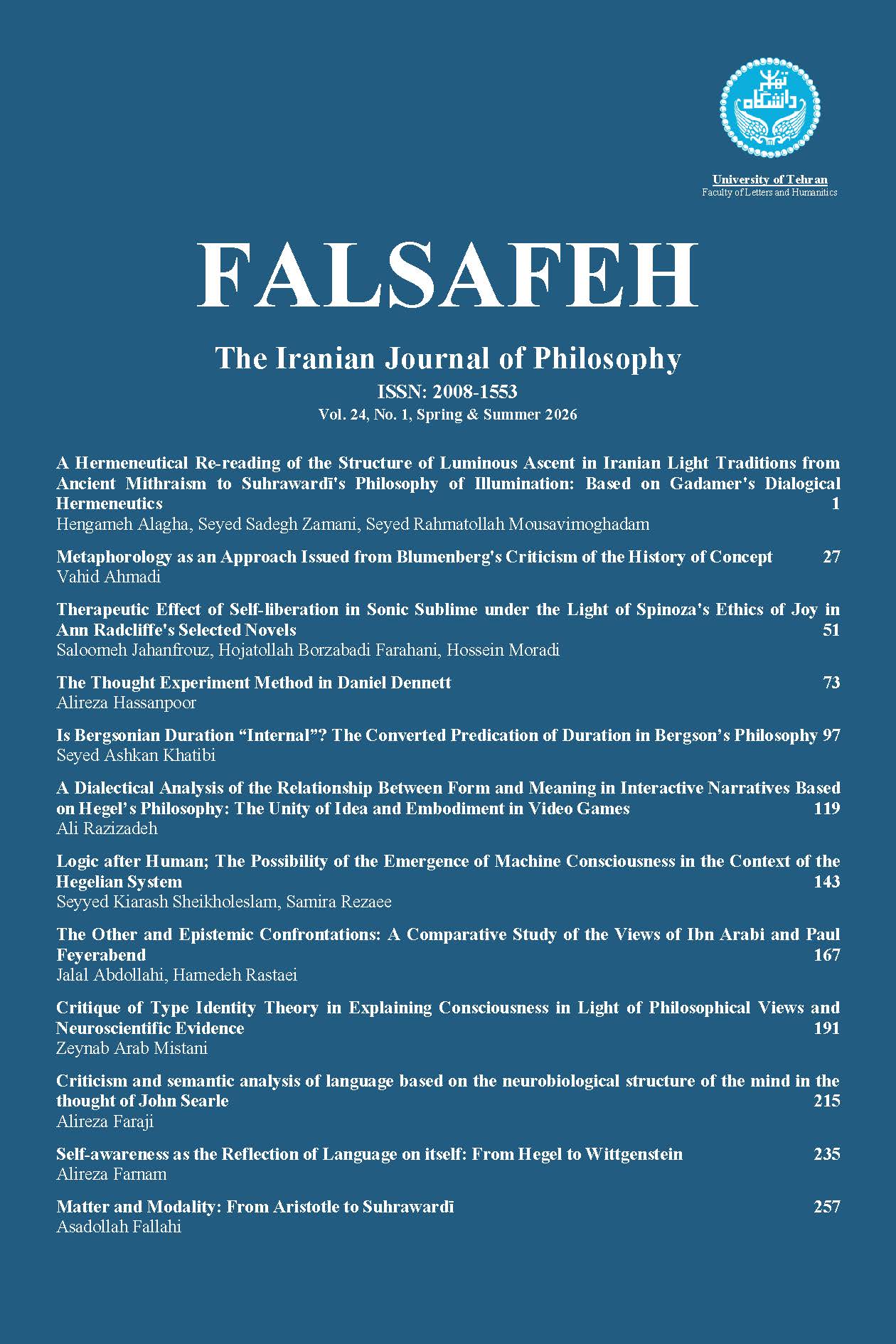
FALSAFEH

FALSAFEH, the biannual journal of the Faculty of Literature and Humanities at the University of Tehran, is a scientific-research publication dedicated to the field of philosophy and its related disciplines. It is published a maximum of two times per year.

Operating within the domain of philosophy, the journal introduces the latest research findings of scholars and university faculty to the academic community. Philosophy, as a discipline, is entrusted with the task of philosophical and rational inquiry into its own nature and fundamental doctrines. By considering both Islamic and Western philosophical perspectives, the journal strives to address diverse viewpoints within the field and to publish articles that adhere to a scientific and research-based standard.

Based on letter No. 3780/11/3, dated May 8, 2010, from the Commission of Scientific Publications of the Ministry of Science, Research, and Technology, FALSAFEH has been granted the rank of "Scientific-Research" journal.

The University of Tehran Journal of Philosophy strives to achieve the following objectives:

  • To acquaint the scientific community with the latest works of researchers and thinkers in the field of philosophy.
  • To critique Western philosophy and work towards the development of Islamic philosophy.
  • To promote the application of philosophy.
  • To demonstrate the rich history and rigor of Islamic philosophy.
  • To move towards theory-building and innovation in the field of philosophy.
  • To respond to doubts and questions concerning philosophical issues in both domestic and international arenas.

Journal Information

  • Journal Title: FALSAFEH (فلسفه)
  • License Holder: Faculty of Literature and Humanities, University of Tehran
  • Publisher: University of Tehran Press
  • English Title: FALSAFEH
  • Scientific Group (Subject): Humanities
  • Sub-group: History - Research - Periodicals
  • Scientific Rank: Scientific-Research (Elmi-Pajouheshi)
  • Date of Accreditation: May 8, 2010
  • Peer Review Type: Double-blind, anonymous, and confidential
  • Average Initial Review Time: Approximately 3 weeks
  • Average Peer Review to Acceptance Time: 3-4 months, with a minimum of two reviewers
  • Acceptance Rate: 14%
  • Publication Frequency: Biannual
  • Journal Language: Persian (Abstracts and references in both English and Persian)
  • Publication Type: Electronic
  • Access Type: Open Access (full text)
  • Print ISSN: 2008-1553
  • Electronic ISSN: 2716-X974
  • Citation Style: APA
  • Phone: +98 21 61112999
  • Journal Email: philosophyj@ut.ac.ir
  • Website: https://jop.ut.ac.ir
  • Article Processing Charge (APC): Yes
  • Final Acceptance and Publication Fee: Yes
  • Copyright: The journal follows the international Creative Commons Attribution (CC BY) license. The copyright of the articles belongs to the authors, who are the owners and rightful holders of the copyright for their work.
  • Committee on Publication Ethics (COPE): The journal "FALSAFEH" respects the ethics of publication and adheres to the guidelines, principles, and regulations of the Committee on Publication Ethics (COPE). It also complies with the executive bylaw of the Law on the Prevention and Combating of Fraud in Scientific Works.
  • Plagiarism and Similarity Check Policy: In accordance with an agreement with Sinaweb, all submitted articles will be checked for similarity using plagiarism detection software (e.g., Samim-Noor, Hamta-Nevis) before entering the peer-review process.

Important Notice for Authors

The journal will charge a fee after the article has been accepted for publication. However, the republication of information from this database is free, provided the source is cited. As per the request of the Commission of Scientific Publications of the country, it is mandatory for authors to register and display a free ORCID iD and to use a university or institutional email address. Therefore, authors are requested to obtain an ORCID iD and a university/institutional email before submitting their manuscript.

Corresponding Author

The corresponding author can be a faculty member of a university, center, or research institute. The submission of the article is free, but a written confirmation letter from the corresponding author and the required forms must accompany the manuscript. Master's and PhD students cannot submit an article as the corresponding author on their own. The responsibility for ensuring the absence of plagiarism, data fabrication, and misuse of artificial intelligence lies with the authors.

Required Files and Forms

The essential files that must be submitted through the article submission system are:

  1. The main manuscript file (without the authors' names and formatted according to the journal's template/guidelines). (Please refer to the "Guide for Authors" section).
  2. The title page file containing the authors' details.
  3. The Commitment Form (must include the article title and the full names of all authors and be signed by all of them). (Please refer to the "Guide for Authors" section).
  4. The Conflict of Interest and Authorship Agreement Form (must be signed by the corresponding author and uploaded with the manuscript file). (Please refer to the "Guide for Authors" section).

Article Template

The final version of the article, after completing the peer-review and acceptance process, must be submitted in the journal's article template. Otherwise, it will not be processed for publication. (Please refer to the "Guide for Authors" section).


Note: For finally accepted articles, authors must prepare an extended English abstract of 1000 to 1200 words, in addition to the short English abstract. This extended abstract must be placed in the article according to the sample template and sent along with other supplementary files via the journal's system. Artificial intelligence (AI) tools may be used to edit the English abstract for the purpose of reviewing spelling, grammar, and rewriting the text.

The Journal of Philosophy will charge a fee of 1,500,000 Rials for the initial review and, upon article acceptance, a publication fee of 4,500,000 Rials (totaling 6,000,000 Rials). To this end, after notification from the journal office, the aforementioned amount must be paid through the online portal available on the journal's website. Alternatively, the amount can be deposited into the following account, and a copy of the deposit slip must be sent to the journal's email.

  • Account Number: 4001070103006825
  • IBAN (SHABA): IR830100004001070103006825
  • Deposit ID: 314070174140107000000002002202
  • Account Name: University of Tehran - Centralized Account for Specialized Funds, Central Bank of the Islamic Republic of Iran.

                              مرکز اسناد و کتابخانه ملی 

Scientific-research
Particularity: the Central Category of the Aesthetic in Lukacs‘ Aesthetic System

marzieh ebrahimi; Hadi Rabie

Volume 23, Issue 2 , February 2026, Pages 1-25

https://doi.org/10.22059/jop.2025.389487.1006880

Abstract
  In this paper, I reconstruct Georg Lukacs’ argument, as it appears in his 1963 the specificity of the Aesthetic. In Lukacs’ point of view the theory of reflection provides ...  Read More
Scientific-research
The Possibility or Impossibility of linguistic Incommensurability in Comparative Studies

Hasan Ahmadizade

Volume 23, Issue 2 , February 2026, Pages 27-47

https://doi.org/10.22059/jop.2025.389819.1006884

Abstract
  Comparative studies scholars believe that the most difficult challenge facing researchers in this field, first and foremost, is the possibility or impossibility of comparability between ...  Read More
Scientific-research
Wittgenstein’s Philosophy of Language, Realism or Idealism?

Hossein Shaqaqi

Volume 23, Issue 2 , February 2026, Pages 73-49

https://doi.org/10.22059/jop.2025.397925.1006915

Abstract
  The later philosophy of Ludwig Wittgenstein is interpreted by some commentators as realist, while others regard it as idealist. Each of these camps supports its interpretation by citing ...  Read More
Scientific-research
A Rereading of Plato's and Aristotle's Educational Philosophies in Light of Davidson's Concept of the
A Rereading of Plato's and Aristotle's Educational Philosophies in Light of Davidson's Concept of the "Relational Self"

Kamrun Shahbazi; Mohammad Hassan Karimi; Babak Shamshiri; Amin Izad panah

Volume 23, Issue 2 , February 2026, Pages 75-97

https://doi.org/10.22059/jop.2025.389644.1006881

Abstract
  To illustrate the distinct and nuanced educational system that arises from a relational perspective on the concept of "self." This article attempts to first, analyze Davidson's concept ...  Read More
Scientific-research
A Comparing the Concept and Phenomenological Function of Intuition of Essence According to Descartes and Husserl

Abdolreza safari

Volume 23, Issue 2 , February 2026, Pages 99-121

https://doi.org/10.22059/jop.2025.387264.1006870

Abstract
  This article, based on a descriptive-analytical method, focuses on the phenomenological role and function of intuition of essence in Descartes and Husserl. Although the author introduces ...  Read More
Bergson’s Footsteps in Heidegger’s Interpretation of Time
Volume 21, Issue 2 , March 2024, , Pages 221-236

https://doi.org/10.22059/jop.2023.349685.1006750

Abstract
  At the beginning of Being and Time, Bergson's name comes alongside Aristotle’s name when Heidegger tried to distinguish the concept of temporality from traditional time. Now, ...  Read More
Descartes’ Pineal Gland: The Seat of the Soul
Volume 12, Issue 1 , August 2014, , Pages 19-38

https://doi.org/10.22059/jop.2014.51915

Abstract
  Explanation of the relationship between soul and body is one of the most important concerns of Dualist philosophers. Even though the Dualism goes back to Plato, Rene Descartes, a French ...  Read More
Peirce's Semiotics in the light of His philosophy, Epistemology and His Vision of pragmatism
Volume 9, Issue 2 , March 2012, , Pages 5-37

Abstract
  This paper presents the most important features of Peirce's semiotics, including the emergence process of signs, their ways of signifying, as well as their practical dimensions. The ...  Read More
A comparative of Aesthetics in Plato,
 And Descartes’ Philosophy
A comparative of Aesthetics in Plato, And Descartes’ Philosophy
Volume 11, Issue 1 , September 2013, , Pages 67-83

https://doi.org/10.22059/jop.2013.36401

Abstract
  Descartes' absolutist rationalism makes a gap between human perception and the physical word. As a result, there will be a separation between his rational approach to the word and that ...  Read More
Aesthetics in Mulla Sadra’s philosophy
Volume 9, Issue 2 , March 2012, , Pages 137-162

Abstract
  Aesthetics, nowadays, is regarded as a branch of philosophy which studies  Beauty and art. This research is about aesthetics from Mulla Sadra's viewpoint. In the works of this ...  Read More
Research Paper
The Philosophy of Dialogue from a Post-Cartesian Perspective: the Confrontation of Language, Culture and Nature

Mostafa Morady Moghaddam

Articles in Press, Accepted Manuscript, Available Online from 28 December 2025

https://doi.org/10.22059/jop.2025.373129.1006820

Abstract
  The discussion on the factors that shape language—instinct or environment—has been a heated debate among researchers in recent decades, leading to the emergence of two perspectives: ...  Read More
Scientific-research
The Nature of Belief from Price's Perspective

Fatemeh Arabgoorchooee

Articles in Press, Accepted Manuscript, Available Online from 28 December 2025

https://doi.org/10.22059/jop.2025.397754.1006914

Abstract
  The present article examines the nature of belief from the perspective of Henry Habberley Price. Price offers a novel analysis of the concept of belief, considering it as a complex ...  Read More
Scientific-research
Some considerations on  the scholastic transcendental philosophy in the light of the metaphysics of Avicenna, Aquinas, and Scotus
Some considerations on the scholastic transcendental philosophy in the light of the metaphysics of Avicenna, Aquinas, and Scotus

Seyed Hamid Talebzadeh; Ali Reza Attarzadeh

Articles in Press, Accepted Manuscript, Available Online from 28 December 2025

https://doi.org/10.22059/jop.2025.401203.1006945

Abstract
  A set of concepts lies at the core of metaphysical thought, constituting the subject and predicate of most metaphysical propositions. The centrality of these metaphysical concepts, ...  Read More
Scientific-research
The Arrow of Time, the Past Hypothesis, and the Layer-Phenomenal Model

Ahmad Ebadi; Amirpouya Danesh

Articles in Press, Accepted Manuscript, Available Online from 01 February 2026

https://doi.org/10.22059/jop.2026.400046.1006940

Abstract
  This article investigates the issue of the directionality of time and its origin at the intersection of physical theories and philosophical analysis. The main focus is on David Albert’s ...  Read More
Scientific-research
Plato's Parmenides: Logical Groundwork of Methexis in the Dialectic of One and Many

Amir Samsami; Aliasghar Mosleh

Articles in Press, Accepted Manuscript, Available Online from 02 February 2026

https://doi.org/10.22059/jop.2025.389680.1006882

Abstract
  The Parmenides is not fundamentally intended to reject, revise, or even correct the dogmatic presuppositions regarding the hypothesis of Ideas. Rather, its aim is to bring those presuppositions ...  Read More

Publisher:
University of Tehran

Director-in-Charge:
Javad Asghari

Editor-in-Chief:
Dr Hamid Talebzadeh

Associate Editor:
Zahra Ghezelbash

Editorial Board:
Gholamreza Awani Mohammad Ilkhani Shahram Pazoki Alvin Plantinga Nasrollah Pourjavadi Reza Davari Ardakani

Manager:
Maryam Moghadam


Frequency: Semiannual

Print ISSN: 2008-1553

Online ISSN: 2716-974X

Indexing and Abstracting

World Cat

Ut

ISC

SID

Noormags

...